

Understanding Story Structure: Three-Act and Five-Part Frameworks.
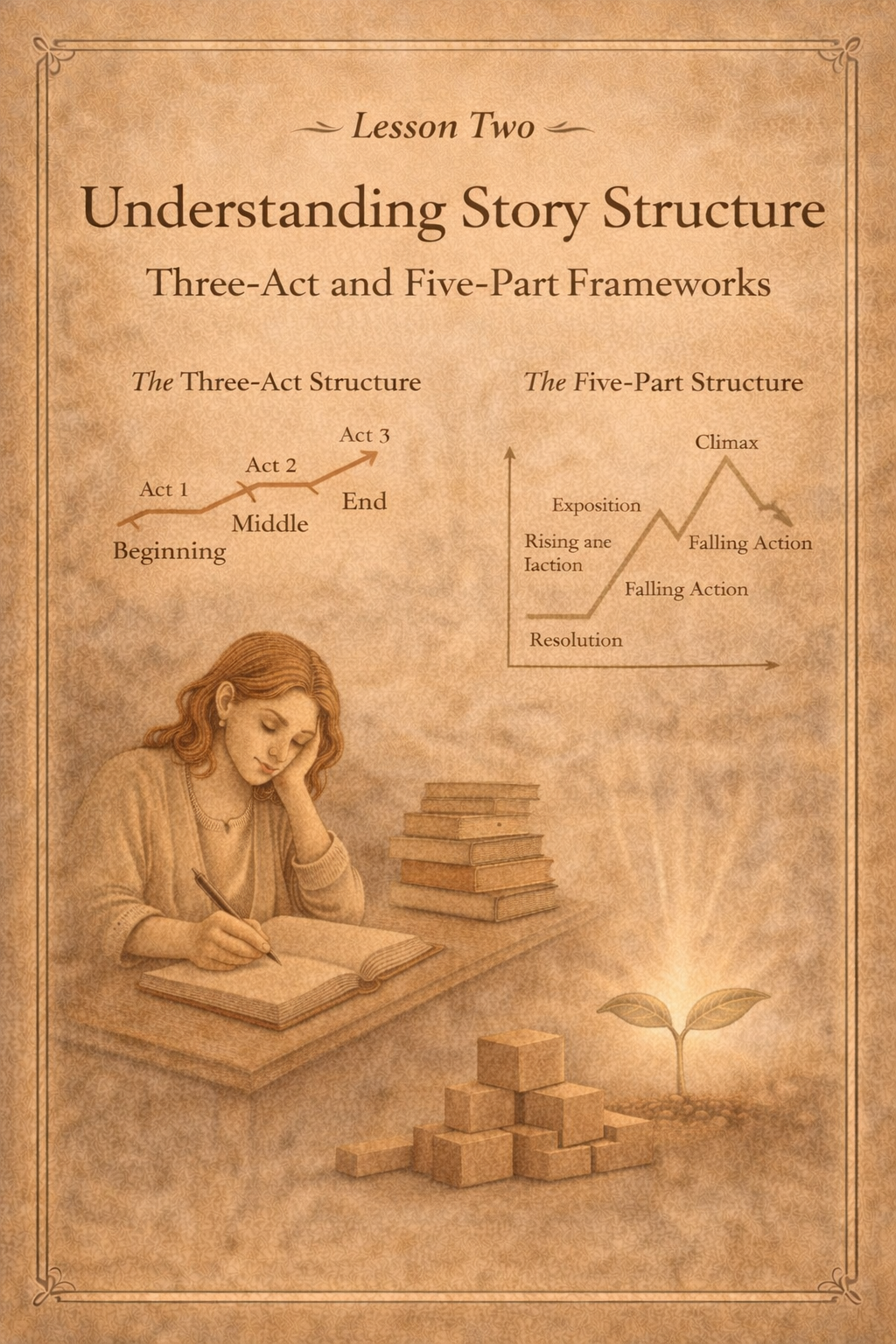
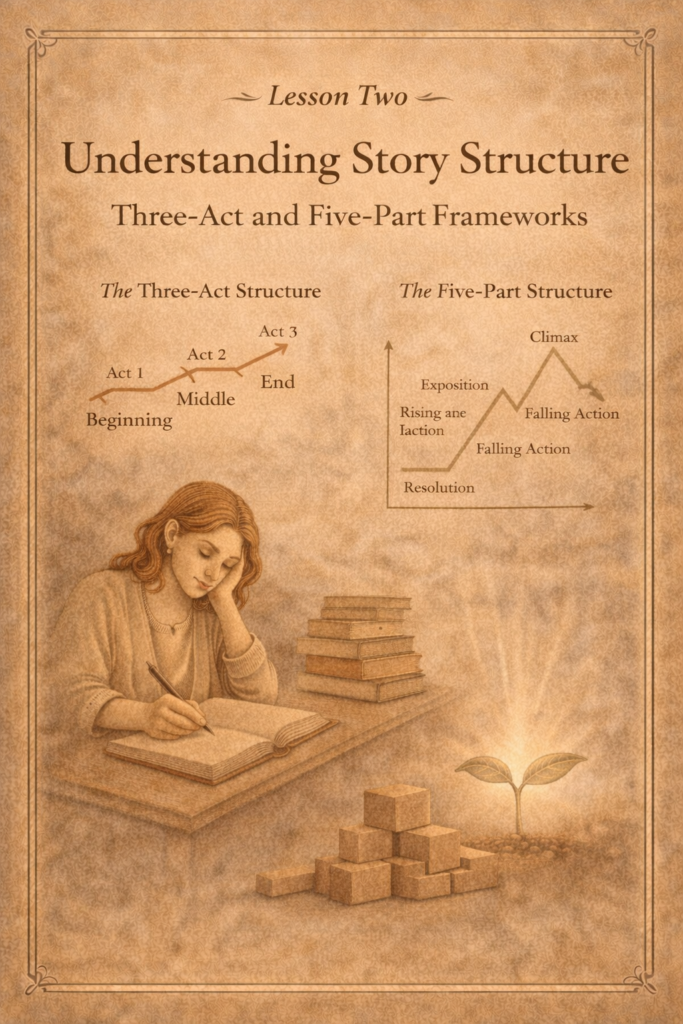
Lesson Two
Understanding Story Structure: Three-Act and Five-Part Frameworks
Lesson Focus
Stories don’t move forward by accident. In this lesson, we’ll explore why structure matters, how both three-act and five-part frameworks work, and how understanding story structure gives your writing direction without stifling creativity.
Why This Matters
Many writers resist structure because it feels restrictive. They worry that outlining or planning will drain the life out of their writing or turn a story into a formula. Others jump in without any structure at all, hoping the story will “find its way.”
More often than not, both approaches lead to frustration.
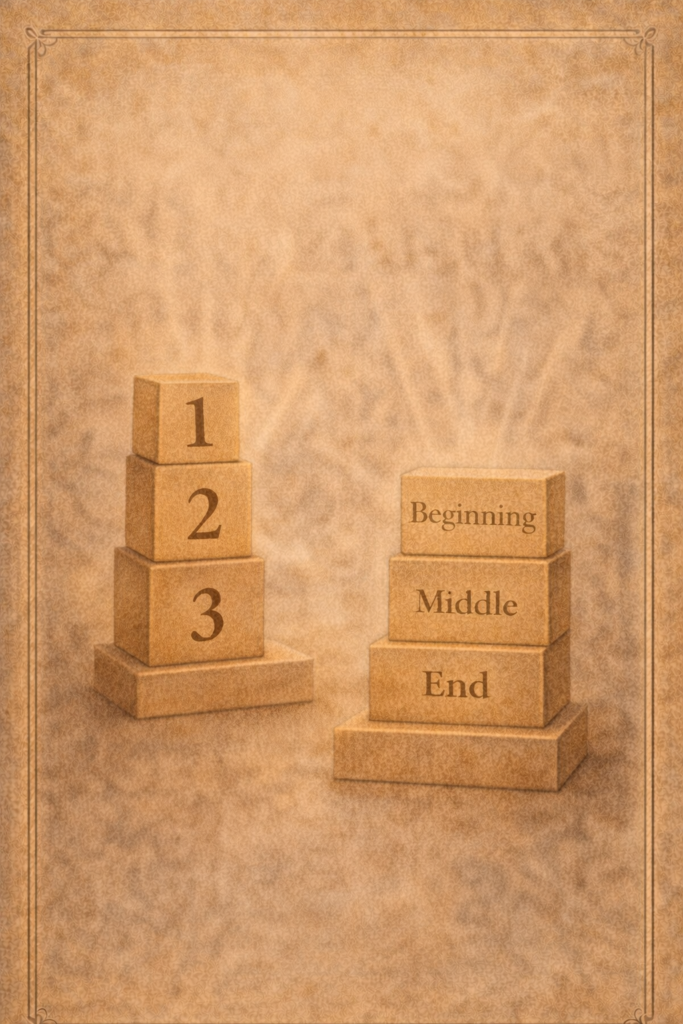
Without structure, stories tend to wander. Scenes feel disconnected. Middles sag. Endings arrive too quickly—or never quite land. Structure doesn’t replace creativity; it supports it. Think of structure as the core building blocks of your story—the framework strong enough to hold your ideas and allow them to grow.
When you understand how stories naturally unfold, you can write with more confidence, make stronger choices, and recognize when something isn’t working long before the final draft.
Core Teaching
What Story Structure Really Is
At its simplest, story structure is the order in which events unfold to create meaning. It’s the underlying framework that helps a story build, deepen, and resolve.
Structure answers questions like:
- Where does the story begin?
- What changes along the way?
- What is at stake?
- How does it end—and why does that ending matter?
Even devotionals follow a form of structure: a truth is introduced, explored, and applied. Structure isn’t exclusive to fiction—it’s part of how we process stories and ideas in everyday life.
The Three-Act Structure
The three-act structure is one of the most familiar and accessible frameworks.
Act One: The Beginning
- Introduces the main character
- Establishes the setting and situation
- Presents the central problem or question
Act Two: The Middle
- Complicates the problem
- Raises the stakes
- Forces the character to respond, struggle, and change
Act Three: The End
- Brings the story to a turning point
- Resolves the central conflict
- Shows the outcome of the character’s choices
This structure works well because it mirrors how we naturally tell stories: something begins, something happens, and something changes.
My current WIP follows the three-act structure. Act One introduces the characters and transitions into the problem they are facing. Act Two begins the investigation and problem-solving. Act Three b
The Five-Part Structure
The five-part structure is similar to the three-part structure, but offers a bit more detail and is especially helpful for longer works.
- Exposition – Introduces the characters, setting, and tone
- Rising Action – Develops conflict and tension
- Climax – The moment of greatest tension or decision
- Falling Action – The immediate aftermath of the climax
- Resolution – Loose ends are tied up and meaning is revealed
This framework helps writers see where momentum should build and where the story should begin winding down. It can be especially useful when a story feels unbalance
Structure as a Guide, Not a Rule
Do you have to use one of these structured outlines? No. You can even create your own structure. However, you’ll soon discover that these tried-and-true frameworks give you a solid foundation to write around—one that delivers the rise and fall readers expect from a satisfying story.
If you’re a new writer, I wouldn’t recommend reinventing the wheel just yet. Understanding structure comes first. Once you know how it works, you can bend it, adapt it, or create something uniquely your own.
It’s important to remember that structure is descriptive, not prescriptive. Stories don’t succeed because they follow a formula; they succeed because they guide the reader through a meaningful journey.
I used to be what’s called a SOP writer—writing by the Seat Of my Pants. My stories would go on and on, never quite getting anywhere. There was no clear climax, no true aha moment, and often no real ending. What I eventually learned is that stories need a turning point and a resolution. This is what readers expect—and deserve.
Examples
Unstructured Approach:
A story introduces an interesting character, moves through several loosely connected scenes, and ends abruptly without resolution. It’s like reading your grandmother’s diary that she started as a young girl. Her life in a different era is interesting, and we see her growth—until she marries and stops writing. We never know how her story truly ends.
Structured Approach:
The story introduces a character with a clear problem, builds tension through escalating challenges, reaches a decisive turning point, and ends with resolution or growth. How much more satisfying to read how Grandma endured her hard life, learned from it, and left us with words of wisdom and a message we carry forward.
The difference isn’t creativity—it’s clarity.
What Not to Do
- Don’t confuse structure with rigidity.
- Don’t force your story to fit a framework that doesn’t serve it.
- Don’t ignore the middle of your story—it’s where growth happens.
- Don’t rush the ending without allowing the story to resolve naturally.
How To Apply This
- Identify whether your current project follows a three-act or five-part structure.
- Write one sentence describing what happens in each act or stage.
- Look for gaps where tension stalls or events feel rushed.
- Adjust scenes so each section serves a clear purpose.
- Remember that structure can be refined during revision.
✦ Desk Notes
Structure doesn’t limit creativity—it gives it a place to stand.
✦ From My Writing Desk
Some of the most helpful breakthroughs I’ve had as a writer came when I finally admitted a story wasn’t broken—it was just unstructured. Once I understood where the story was supposed to rise, turn, and resolve, the revisions became clearer and far less overwhelming.
Exercises
- Story Mapping:
Choose a favorite book or Bible story and identify its three acts or five parts. - Your Story Outline:
Write a brief description of your beginning, middle, and end. - Middle Check:
What changes for your main character in the middle of the story? - Reflection:
Where does your story feel strongest—and where does it lose momentum?
Optional Reading
Affiliate Disclosure: Some of the links on this site are affiliate links. This means I may earn a small commission — at no extra cost to you — if you choose to make a purchase.
I only share products I personally use, love, or believe will genuinely help my reader’s journey. Thank you for supporting my website and helping me keep creating free content.
Looking Ahead
Click here for the next lesson: Building Characters: Backstory, Motivation, and Meaningful Details.
If these free writing lessons lessons encourage you to write with more confidence, more clarity, and a little more courage, then they’ve done what they were meant to do.
Welcome to The Writing Desk.
If you haven’t already joined my Reader’s Circle, please do so. Right away, you’ll receive a short story exclusive to my subscribers. You’ll also discover more editing and writing tips. Come join me in my journey as an author. If you subscribe you will receive a weekly update on the posts I am creating for that week.
Comments
Understanding Story Structure: Three-Act and Five-Part Frameworks. — No Comments
HTML tags allowed in your comment: <a href="" title=""> <abbr title=""> <acronym title=""> <b> <blockquote cite=""> <cite> <code> <del datetime=""> <em> <i> <q cite=""> <s> <strike> <strong>