

Ten Ways to Make your First Five Pages Sparkle
If you’ve ever heard the saying “your first five pages can make or break a book,” you know there’s a little truth and a lot of pressure wrapped up in it. Those first pages are where readers, agents, and editors decide if they’re in good hands. They want clarity, voice, movement, and a hint of the promise your story will deliver.
I’ve been deep in this process myself. In fact, I recently made the tough decision to cut the first three chapters of my work-in-progress. Yep—gone. Snipped clean like thread tails on the back of an embroidery project. Why? Because I finally admitted my protagonist didn’t show up until chapter four. That’s a long time to keep a reader waiting!
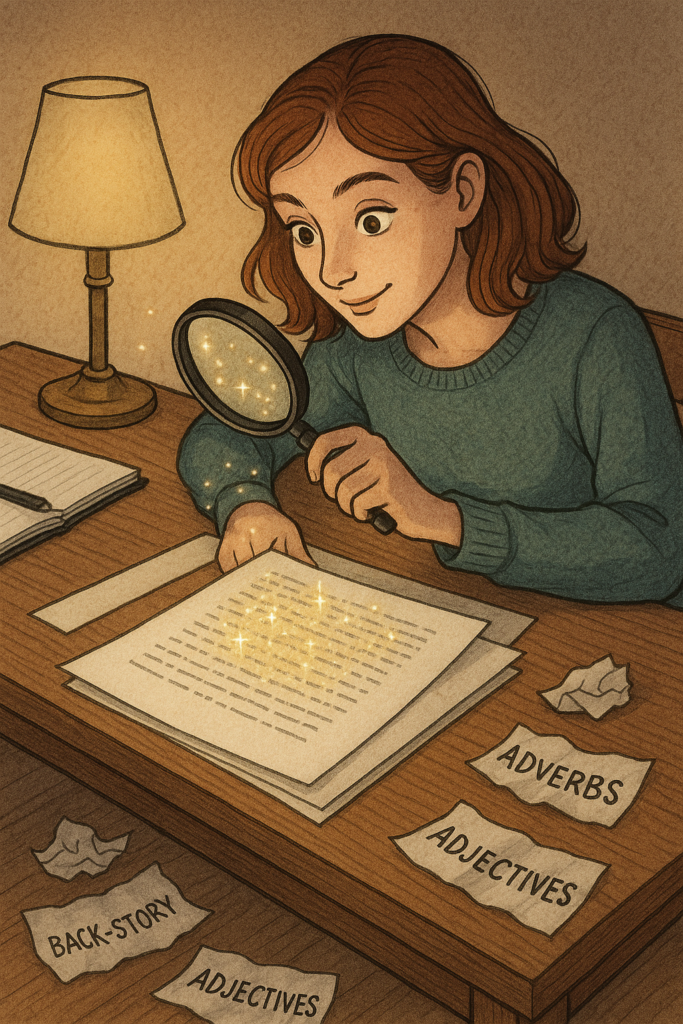
Was that early writing wasted? Not at all. Those chapters were where I met my victim—the character who disappears at the start of the story. I figured out his personality, quirks, and why someone might want him gone or why he might want to make himself disappear. Even though he never appears on the page early, he shaped every reaction from every other character. Writing those chapters was like sketching under a painting: the reader never sees the pencil lines, but the artwork wouldn’t exist without them.
Here are ten ways you can help your first five pages shine—whether you’re drafting fresh pages or polishing a nearly-there manuscript.
1. Bring Your Main Character in Quickly
Readers bond with people, not plot points. Let them meet your protagonist early enough to invest emotionally if the most important person doesn’t show up until page 40. Ask me how I know.
2. Start With Movement, Not Backstory
You don’t have to open with a car chase or a burning building, but give us a sense of motion—someone wanting something, trying something, reacting to something. Curiosity pulls readers forward.
3. Trim the Extras (Sorry, Adverbs)
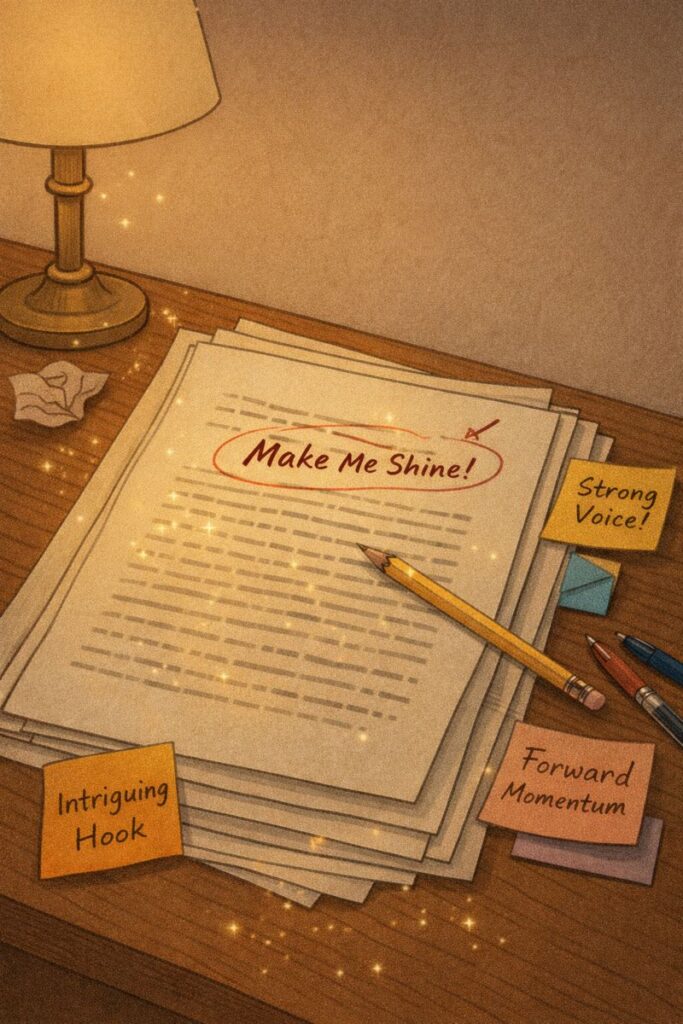
After revisiting my pages, I went back and cut adjectives and adverbs as Noah Lukeman suggests in The First Five Pages. It’s incredible how much stronger a sentence becomes when the verbs do the heavy lifting.
4. Read It Out Loud—Every Word
Reading out loud is an old freelance-editor habit of mine, and it still works like a charm. If you stumble, pause, or reread, that’s your manuscript saying, “Fix me.” If a reader stumbles on your words, you interrupt the flow of the story for them.
5. Make Dialogue Clear
If you can’t tell who’s talking without checking the tags, your reader won’t know either. And if you’ve got so many people in one room that the lines get tangled, consider thinning the crowd. Not every character needs a front-row seat.
6. Ground the Reader in the Setting
Give us one or two sensory details so we know where we are—a smell, a texture, a sound—just enough to anchor the scene. Too little feels floaty, too much slows the pace.
7. Raise a Question
Readers love a little mystery. Make them ask themselves questions about what will happen next. Don’t answer the questions immediately. Give your story that tad of suspense. It moves your story forward. You’ll answer it when the time is right.
8. Check That Every Paragraph Has a Purpose
Ask yourself: Does this move the story forward? Does it reveal character? Does it raise tension? If not, it goes into the scrap pile..
9. Make Your Voice Shine
Your voice is what makes you you on the page. Play with rhythm, humor, and emotion—whatever tone fits your story. Write from your heart as though talking to a friend.
10. End Your Fifth Page With Forward Momentum
Think of it as closing a chapter of curiosity rather than completion. You want your reader leaning in, not leaning back. A new shift—a new worry, a surprising reaction, a question left hanging—creates just enough momentum to make turning the page irresistible.
Final Thoughts
Cutting chapters, trimming adverbs, reading aloud—none of it is wasted effort. It all strengthens your instincts and sharpens your storytelling. Those “lost” chapters you toss? They’re never truly lost. They inform your characters, deepen your world, and make the surviving pages shine brighter.
If you ever feel discouraged during those early edits, remember: glitter doesn’t stick without a bit of glue, and sparkling first pages don’t appear without trimming.
If you haven’t joined my Reader’s Circle yet, please do so. When you join, you get a free short story delivered to your inbox – exclusively for my subscribers. I won’t bombard you with emails, but will occasionally send you newsletters and updates. No spam.
Affiliate Disclosure
Some of the links on this site are affiliate links. This means I may earn a small commission — at no extra cost to you — if you choose to make a purchase.
I only share products I personally use, love, or believe will genuinely help my reader’s journey. Thank you for supporting my website and helping me keep creating free content.
If you are interested in Noah Lukeman’s book, The First Five Pages, click here.
Comments
Ten Ways to Make your First Five Pages Sparkle — No Comments
HTML tags allowed in your comment: <a href="" title=""> <abbr title=""> <acronym title=""> <b> <blockquote cite=""> <cite> <code> <del datetime=""> <em> <i> <q cite=""> <s> <strike> <strong>